
 G
G


Laser eye surgery terminology – do you know your LASIK from your keratectomy from your SMILE?
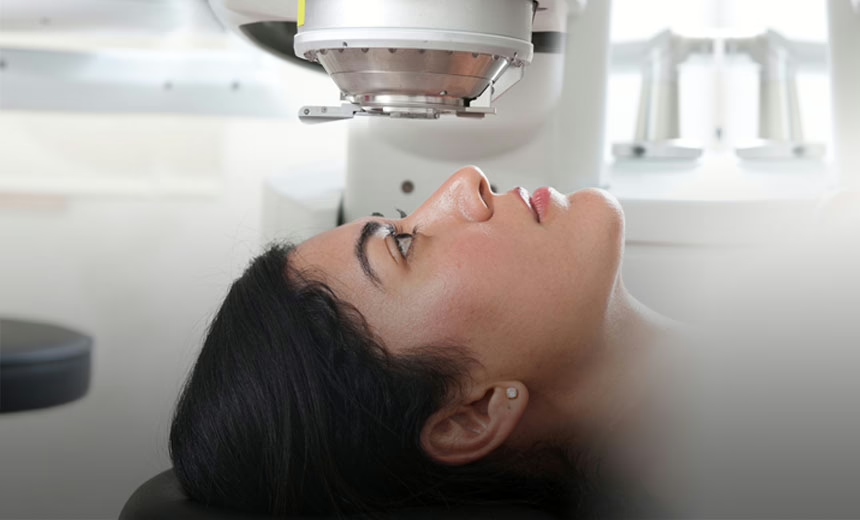
Thinking about laser eye surgery? You’ll quickly notice it comes with a language of its own – acronyms, medical terms and technical details that can be confusing at first glance. The good news is you don’t need to be an expert in the jargon. That’s what your surgeon is for.
Your laser eye surgeon will guide you through your options and recommend the treatment that matches your eyes, needs and visual goals. Nonetheless, if you’d like to feel more comfortable with the language, here’s a list of the most common terms you might come across along the way.
Ablate
In surgery, to ablate is to remove (see ASLA).
Ablation zone
The ablation zone is the precise area of your cornea where the laser removes tissue to correct your vision.
ASLA (advanced surface laser ablation) or PRK (photorefractive keratectomy)
ASLA or PRK was the first laser eye surgery option introduced and is still in use today. The procedure involves removing the epithelial layer (the top layer of the cornea). This layer naturally regenerates after surgery. Once the layer is removed, the excimer laser is used to reshape the underlying corneal tissue.
Correcting short-sightedness (myopia) involves removing tissue from the middle part of the cornea to create a flatter surface. Correcting long-sightedness (hyperopia) requires removing tissue from the corneal edges. Excimer lasers correct astigmatism by reducing corneal irregularity and providing a more regular shape for improved light refraction.
Astigmatism
A deviation of a spherical curve (the cornea) resulting in distorted images. In classic Greek, the ‘a’ is ‘without’, while the ‘stigmata/stigmat’ refers to a point – so it is literally ‘without point’. Astigmatism is a common refractive error that can be corrected with laser eye surgery.
Bandage contact lens
This is a contact lens worn after some procedures, such as PRK, to aid healing and protect the cornea until eye health improves.
Bladeless (all-laser) LASIK
Bladeless LASIK replaces the traditional microkeratome blade with a femtosecond laser to create the corneal flap. This all-laser approach allows for a more predictable flap thickness and reduced risk of complications. The remainder of the procedure is performed in the same way as conventional LASIK.
Epi-LASIK – epithelial LASIK
Epi-LASIK is a variation of LASEK (see definition below), in which the thin outer layer of the cornea (epithelium) is separated using a special mechanical instrument, rather than an alcohol solution. The epithelium is lifted, the underlying corneal tissue is reshaped with an excimer laser, and then the epithelium is repositioned. A protective contact lens is applied to support healing.
Epithelial layer
The cornea consists of five layers, and the top layer is called the epithelial layer. Laser eye surgery involves the epithelial layer (the epithelium) and the stromal layer (the stroma).
Excimer laser
An excimer laser uses gas to produce energy through which the cornea can be permanently reshaped without the need for any heat. No burning occurs.
Femtosecond laser
A femtosecond laser is used in LASIK and SMILE® and SMILE pro laser eye surgery. The word ‘femtosecond’ relates to the amount of time it takes for a single pulse – a ‘femtosecond’ converts to approximately one quadrillionth of a second.
The purpose of the femtosecond laser is to either create the ‘flap’ of tissue that can be lifted and replaced back into its original position (during LASIK) or create the stromal lenticule directly for removal (during SMILE and SMILE pro).
Flap
This is a thin, hinged flap of tissue created on the eye’s outer layer of tissue (the cornea) during LASIK.
Creating a flap involves making a plane incision across the corneal tissue, which can be gently lifted (while remaining attached in one segment) to expose the middle layer of the cornea (the stroma), allowing the surgeon to use the excimer laser to reshape it and correct vision problems.
Once the stroma is sculpted, the flap is repositioned and naturally seals back into place, with the underlying tissue reattaching within a day.
Hyperopia
In Greek, ‘hyper’ means ‘beyond’ and ‘ops’ means ‘eye’. A person with hyperopia can see objects in the distance more clearly than objects that are close by. It is also called long-sightedness or far-sightedness. Laser eye surgery can be used to correct hyperopia.
Infrared eye tracker
An infrared eye tracker is smart technology built into many laser systems. Using infrared light and high-speed cameras, an infrared eye tracker continuously monitors even the smallest eye movements, including blinks, and automatically keeps the laser aligned with the treatment area on your cornea. This tracking system enhances both safety and accuracy, ensuring your procedure is precise.
Keratectomy
Refers to the surgical removal of a layer of the cornea.
Keratomileusis
Keratomileusis refers to the reshaping of the cornea to correct a refractive error – ‘kerato’ relating to the cornea, and ‘mileusis’ a reference to the Greek term for ‘carving’. Granted, this is not the most elegant description of laser vision correction.
LASEK – laser epithelial keratomileusis
LASEK is a laser eye surgery procedure where an alcohol solution is applied to gently loosen the thin outer layer of the cornea (the epithelium), which is then carefully lifted to expose the tissue underneath. An excimer laser then reshapes the cornea to improve vision. Once the treatment is complete, the epithelial layer is repositioned and protected with a bandage contact lens to support healing.
LASEK is an alternative for people with thinner corneas who may not be suitable for LASIK.
LASIK – laser in-situ keratomileusis
The term LASIK refers to laser-assisted in-situ keratomileusis. This type of laser eye surgery differs from ASLA (or PRK) in the way a surgeon accesses the cornea. Instead of removing the entire epithelial layer, the process requires creating a flap.
With the flap open, the surgeon reshapes the corneal tissue. When the procedure is completed, the flap is closed. As the eye does not have to recreate the entire epithelial layer, recovery time is much faster.
Lenticule
‘Lenticular’ refers to something that is curved on both sides. Lenticule is the term for a ‘disc-shaped piece of corneal tissue’. The individual’s refractive error and corneal shape determine the precise thickness of the lenticule. When it is removed, the curvature of the cornea is reshaped and vision is corrected.
Microkeratome
A microkeratome is a mechanical device, typically a metal blade or a femtosecond laser, used to create a hinged flap in the cornea, allowing access to the stromal layer for laser treatment.
Monovision (or blended vision)
This is a laser eye surgery technique that involves correcting one eye for distance vision and the other for near vision, typically to address presbyopia. The brain then learns to ‘blend’ the images from both eyes, reducing or eliminating the need for glasses.
Monovision can be simulated prior to surgery with the clinic’s lenses or through a contact lens trial.
Myopia
In Greek, ‘ops’ refers to ‘eye/look‘, ‘myein’ to ‘shut’. Myopia literally means ‘trying to see like a mole’. You may know ‘myopia’ better as short-sightedness or near-sightedness. Laser eye surgery can correct myopia.
Presbyopia
Presbyopia is the age-related loss of the eye’s ability to focus on close-up objects, usually beginning in your early 40s. It occurs as the eye’s natural lens gradually loses flexibility with age. Common signs include blurry near vision and needing to hold reading material further away. Presbyopia is a normal part of ageing rather than a disease.
Radial keratotomy
One of the first refractive surgical procedures, radial keratotomy involves creating multiple corneal incisions to flatten and reshape the cornea, thereby reducing its focusing power.
Following the introduction of more accurate and stable laser refractive surgery techniques, such as ASLA/PRK, LASIK and SMILE/SMILE pro, the use of radial keratotomy as a refractive procedure has become limited.
Refractive
Refractive refers to the measurement of the focusing characteristics of the eye. A refractive error is created when the light focusing through the cornea and lens does not focus clearly on the retina. This can be due to an unusual eye length, or incorrect power or curvature of the lens or cornea.
Refractive surgery
This is a broad umbrella term that refers to any surgical procedure that corrects a refractive error, so you rely less on glasses or contacts. This includes laser eye surgery procedures targeting the surface of the eye (like LASIK, PRK or SMILE pro) or procedures that involve deeper structures of the eye (such as refractive lens exchange or implantable contact lenses).
SBK – sub-Bowman’s keratomileusis
Another term for epi-LASIK or LASEK.
SMILE® and SMILE pro – small incision lenticule extraction
The term SMILE refers to small incision lenticule extraction. This form of laser vision correction does not require the surgeon to create a corneal flap. Instead, the procedure involves making a tiny keyhole incision to remove the lenticule created by the femtosecond laser. The SMILE technique may be a suitable option for patients suffering from chronic dry eyes or for those with thinner corneas.
SMILE pro is the most recent advancement of this technique. It performs the same bladeless, one-laser procedure as SMILE but uses the VISUMAX 800 laser to halve the laser treatment time to 10 seconds per eye, as well as providing more control for the surgeon to adjust for the individual shape and orientation of the patient’s eye. By shortening the laser treatment time, SMILE pro can help improve patient comfort and reduce patient anxiety during laser eye surgery.
SMILE ‘lookalike’ procedures
Refractive lenticule removal procedures similar to SMILE and SMILE pro (e.g. SILK, SmartSight, LaLex and CLEAR) have recently emerged. These are laser-dependent variations of SMILE, rather than truly new techniques. Currently, there is little evidence demonstrating any clinically significant benefit over SMILE, which remains the most established and validated lenticule-extraction technique in the literature.
Stroma
The layer of the cornea that sits under the superficial epithelial layer. This is the layer that requires reshaping during laser eye surgery to correct vision.
Topography-guided LASIK/PRK
This advanced technique customises treatment based on a detailed map of the cornea’s surface. By targeting irregularities in corneal shape, topography-guided LASIK or PRK can deliver precise results, benefiting patients with uneven corneas or scarring, or those who have experienced complications from previous surgery.
TransPRK – transepithelial photorefractive keratectomy
TransPRK is a ‘no-touch’ version of PRK. Instead of manually removing the cornea’s surface layer (epithelium), the excimer laser removes it and reshapes the underlying tissue in one step. As no instruments physically touch the eye, TransPRK offers a gentler alternative and can shorten procedure time.
Wavefront LASIK (custom LASIK)
Wavefront aberrations represent a clinical analysis contributing to both the level and the quality of vision seen by an individual. Low-order aberrations represent your refractive error (e.g. myopia, hyperopia and astigmatism), while high-order aberrations represent the subtle irregularities that may impact your quality of vision (that is, how you see under different conditions). This LASIK technique uses the wavefront profile to customise the laser to your corneal shape. Each LASIK procedure includes this correction; however, in some situations – such as previous corneal or laser surgery where there are greater aberrations – further adjustment may be required to optimise the correction.
Seeing it all come together
You don’t need to become fluent in medical terminology to benefit from laser eye surgery – that’s your surgeon’s role. What matters most is your comfort, safety and the end result. With our experienced team supporting you, you can step into surgery confident that every detail is being taken care of.
The information on this page is general in nature. All medical and surgical procedures have potential benefits and risks. Consult your ophthalmologist for specific medical advice.
Date last reviewed: 2026-06-18 | Date for next review: 2028-06-18
