
 G
G
Presbyopia eye drops: worth the hype?
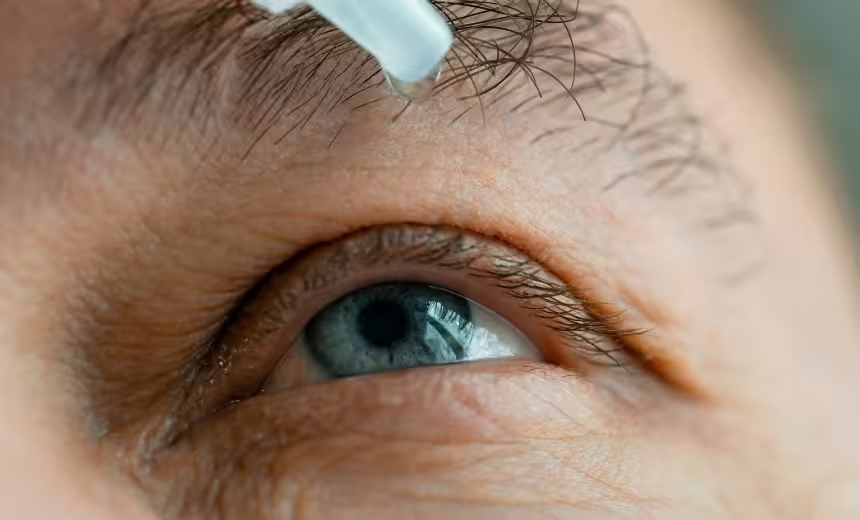
Miotic eye drops have recently joined the list of available options for presbyopia management. However, it remains to be seen if they reach their full potential, and where they fit in the treatment paradigm of presbyopia.
Presbyopia, an unavoidable consequence of ageing, is expected to affect an estimated 2.1 billion people by 2030.1 These skyrocketing numbers are due to a longer life expectancy and an increased reliance on near-vision activities, including the use of mobile phones, tablets and personal computers.
Presbyopia arises gradually as a loss of accommodation secondary to lens stiffening, ageing of the ciliary muscle and zonules, with a progressive inability to achieve near focus. There are also secondary neuronal changes in the brain that are poorly understood.2,3
For most ageing adults, presbyopia is an annoyance, as some people feel disabled by the reduced near vision, having to look around for lost glasses both at work and in the home environment.
Currently, the treatments offered to patients for presbyopia are glasses, contact lenses, and lenticular and refractive laser surgical solutions. All these treatments have trade-offs, especially for early presbyopes in their 40s and 50s, and patients are demanding reversible non-surgical options. It is important to note that some patients would prefer a non-surgical solution to presbyopia, if it was commercially available, to avoid surgical risks such as dry eye, reduced stereopsis and any general surgical risk.
The ideal presbyopia eye drop would act within minutes, have a minimal side-effect profile, and allow for repeatable use during a session of ‘near work’ without affecting distance vision.
Presbyopia eye drops have gained popularity in research following the assumptions of the most widely accepted theory on accommodation from Hermann von Helmholtz, among others, which focused on two concepts: miotic drops and lens softening drops.
Miotic drops
Miotic drops use parasympathetic agents to induce miosis and a pinhole effect by pupillary constriction, avoiding ciliary muscle contraction and increasing the depth of focus, potentially stimulating limited accommodation in early presbyopia.
Miotic drops have obtained US FDA approval, with pilocarpine 1.25% and 0.4% approved respectively in 2021 and 2023, aceclidine in the summer of 2025, and the combination carbachol-brimonidine in January 2026.4–6
Clinical trials on these molecules have shown positive results.
Pilocarpine
Of the presbyopic patients receiving pilocarpine 1.25% once a day, 30% gained three lines of near vision at three hours, with an onset of 15–30 minutes and a duration of six hours. Nearly half of the patients receiving pilocarpine 0.4% twice a day gained three lines at one-hour post-dose, with an onset of 20 minutes and a duration of eight hours. Pilocarpine has also been shown not to affect distance vision, as in these trials there was no reported loss of more than five letters for distance vision.4
Aceclidine
The FDA has recently approved aceclidine 1.44% (Vizz) as a non-invasive, non-surgical treatment for presbyopia in adults.5 Clinical data has indicated rapid onset of near vision improvement after instillation. Aceclidine acts primarily as a pupil-selective miotic, contracting the iris sphincter with minimal ciliary muscle stimulation. This pinhole effect produces a sub-2 mm pupil that increases depth of focus and improves near vision without inducing a myopic shift. Two-thirds of patients receiving aceclidine once daily gained three lines at three hours, with an onset of 30 minutes and duration of about 10 hours.
Aceclidine is more pupil-selective and has been proposed to offer advantages over other miotics, although confirmatory head-to-head studies with other agents like pilocarpine are still lacking.
Combined drops
A more recent development is the combination of carbachol-brimonidine.
Carbachol is a cholinergic agonist that acts through pupillary miosis and relaxation of the ciliary muscle – it is far more potent in its effect when compared to pilocarpine. Brimonidine is an alpha-2 agonist that is used to treat high intraocular pressure (IOP) and is often used in the management of glaucoma. One additional effect is the reduction in sympathetic tone resulting in pupil miosis of 1–2 mm.
The combination of carbachol and brimonidine is typically administered once daily and produces gains of three lines of near acuity in 40% of patients at one to two hours, with an onset of 30 minutes and duration of 8 hours.6
Lens softening drops
In contrast, lens softening drops try to address the root cause of the problem of presbyopia by breaking disulfide bonds, decreasing lens stiffness, and increasing so-called ‘true’ accommodation. One problem not addressed with these drops is the weakening of the ciliary muscle as a consequence of ageing, thus minimising the effect of this treatment. Lens softening drops failed Phase 2 clinical trials in 2022.4
Other considerations
Real-world data suggests that while patients report improved near vision for tasks such as reading phones, such benefits do not extend to prolonged reading activities, and the effect is not sustained. Early to moderate presbyopes (+1.00 D to +1.50 D) appear to do best with topical pharmacological agents.
Side effects with agents like pilocarpine can include headache and brow ache, transient blur, dim vision at night, and some instillation discomfort with associated conjunctival hyperaemia.
Moreover, there are some safety concerns about the risk of retinal detachments with pilocarpine, especially in high myopes and patients with lattice degeneration.
Prior to commencing pilocarpine, it is imperative to perform a thorough retinal evaluation of the fundus, especially in the myopic patient to exclude peripheral abnormalities such as lattice degeneration. Furthermore, patients need to be educated on the signs and symptoms of a retinal detachment such as flashes, floaters and visual field changes.
There is also a concern about driving with very constricted pupils and reduced night vision, especially in patients who are developing cataracts.
Overall
A thorough evaluation of these drops is very important: the selection of patients, consideration of pre-existing ocular conditions, risk factors and the degree and progression of presbyopia, especially with a combination of parasympathetic agents.
Future developments in this area may help patients who are not surgical candidates or prefer to avoid surgery for their presbyopia.
There was a lot of hype in the beginning, but expectations were set too high and they have outpaced the results. Additional concerns include long-term safety of these agents, durability of effect, adherence with chronic use and cost effectiveness.
The use of miotics is an evolving field and we await further developments in this area in the coming years.
- Markoulli M, Fricke TR, Arvind A et al. BCLA CLEAR Presbyopia: Epidemiology and impact. Cont Lens Anterior Eye. 2024;47(4):102157.↩
- Chang DH, Waring GO, Hom M, Barnett M. Presbyopia treatments by mechanism of action: a new classification system based on a review of the literature. Clin Ophthalmol. 2021;15:3733–3745.↩
- Glasser A, Campbell MC. Biometric, optical and physical changes in the isolated human crystalline lens with age in relation to presbyopia. Vision Res. 1999;39(11):1991–2015.↩
- Grzybowski A, Kapitanovaite L, Zemaitiene R. An updated systematic review of pharmacological treatments for presbyopia. Adv Ophthalmol Pract Res. 2024;4(4):220–225.↩↩2↩3
- U.S. Food and Drug Administration. Vizz (aceclidine ophthalmic solution) 1.44%: prescribing information [Internet]. Silver Spring (MD): U.S. Food and Drug Administration; 2025.↩↩2
- Abid MA, Abid MH, Afzal MD. Yuvezzi (carbachol and brimonidine tartrate) dual-agent eyedrops: a new option for presbyopia. Ann Med Surg (Lond). 2026;88(5):3020-3021.↩↩2

This article is for educational and informational purposes only and may not be directly applicable to your individual patients.
Date last reviewed: 2026-10-15 | Date for next review: 2028-10-15
